GET UPDATES

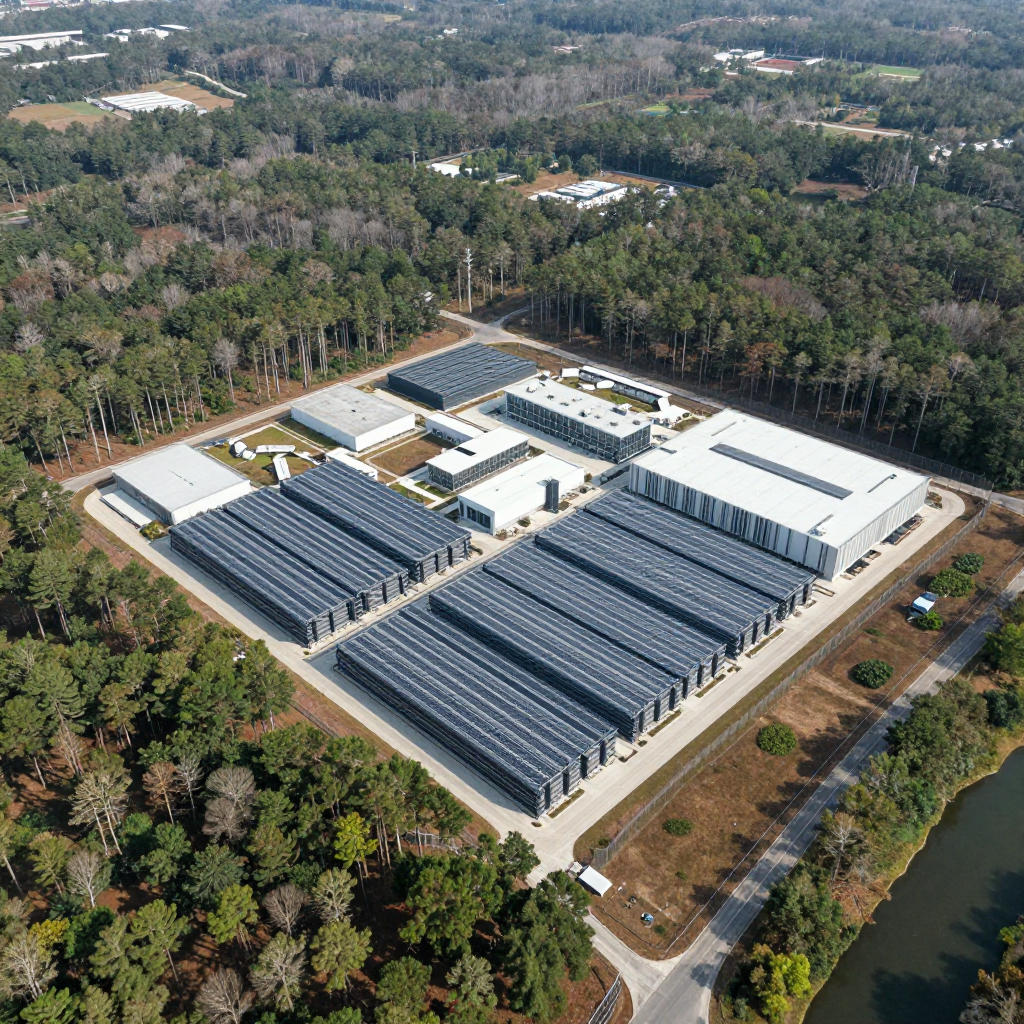
By the end of 2025, metro Atlanta had become the second-largest data center market in the United States, according to CBRE. Georgia Power was projecting roughly 8,500 megawatts of load growth over six years, up from 400 megawatts in its 2022 forecast.
Atlanta is one visible part of a much larger shift. The U.S. South is projected to absorb half of the nation’s population growth by 2040, while electricity demand is expected to double. The region has also captured more than half of U.S. manufacturing investment over the past decade. Data centers, advanced manufacturing, energy, and defense are among the industries driving that growth.
New industries coming to Southern states are choosing their locations based on whether the conditions exist that allow them to operate and expand. They need water, protection from repeated disruption, room to expand, and surrounding land uses that remain compatible with long-term operations. Working forests help provide those conditions. Forest soils and vegetation absorb rainfall, reduce runoff and sediment, and protect streams and reservoirs. Managed forests can lower wildfire fuel, while large areas of undeveloped working land can buffer facilities from incompatible growth.
These functions have economic value. They rarely appear in a siting model or balance sheet.
State and private forestlands provide about a third of the South’s surface drinking water, serving roughly 29 million people. Forests absorb rainfall, slow runoff, hold soil in place, and reduce the amount of sediment reaching streams and reservoirs. Managed forests can also lower wildfire risk and preserve open land around infrastructure, industrial sites, and military installations.
Those functions matter to operations because their loss can create real costs. When upstream forests are cleared or poorly managed, water treatment can become more expensive and flood exposure can increase. Development around an installation or industrial site can reduce buffers, limit future expansion, and create conflicts with noise, smoke, traffic, or other necessary activities. Fire risk rises where fuels accumulate near power lines, roads, and facilities.
Forests do not control any of these conditions by themselves. Infrastructure, planning, regulation, and emergency response all matter. But the condition of the surrounding landscape affects how reliably a facility can operate and how well it can recover when something goes wrong.
The economic problem is that the landowners maintaining those forests are rarely paid for the benefits they provide beyond their property lines. A utility may benefit from cleaner source water. A community may face less flood damage. An installation may retain the space it needs to function. None of that income necessarily reaches the person paying for thinning, prescribed fire, reforestation, or storm recovery.
At the same time, forestland is competing with development. In many parts of the South, the land is worth more for what can be built on it than for what it can earn through timber. Weak markets, rising management costs, and succession decisions make that gap harder to ignore. Selling can be the more rational choice.
Keeping Forests is developing investment structures that begin with a specific dependence, such as water reliability, fire risk, or compatible land use, and connect it to the forest management that can help protect it. Companies, agencies, and funders can support that work through local partners who already know the landowners and the landscape. The arrangement has to show what was funded, what happened on the ground, and why the investment matters to the institution paying for it.
The purpose is to make the value of those forest conditions visible before they are lost, and to move some of that value back to the people managing the land.
By the early 2000s, development around military installations was beginning to interfere with training. Subdivisions moved closer to range boundaries. Night operations became harder to conduct, while complaints about noise and smoke increased. Managing the land inside an installation was no longer enough. Military readiness also depended on the farms and forests beyond the fence.
Congress responded in 2002 by authorizing what became the Readiness and Environmental Protection Integration program, or REPI. The program allows the Department of Defense to invest in easements and land management on nearby private property when development or poor land conditions threaten the military mission.
The Sentinel Landscapes Partnership expanded that approach in 2013 by coordinating Defense Department investments with programs administered by the Departments of Agriculture and the Interior. Through fiscal year 2021, the partnership and its state, local, and private partners had invested more than $1 billion, permanently protected roughly 600,000 acres, and enrolled more than 3 million additional acres in land management programs. As of 2024, six designated Sentinel Landscapes were in the South, including eastern North Carolina, southern Georgia, the South Carolina Lowcountry, and northwest Florida.
REPI established a practical precedent. The military identified a mission risk originating beyond property it controlled, dedicated funding to address it, and worked through local organizations that already knew the landowners. Easements, technical assistance, and management payments helped keep farms and forests in production while giving installations greater certainty about the land around them.
The same problem appears across the civilian economy. Long-term operations depend on watersheds, fire conditions, surrounding land uses, and other landscape conditions that no company controls on its own. Most companies and public agencies, however, have no equivalent of REPI: no established authority, budget, or local delivery system for investing in private land that supports their operations.
Keeping Forests is developing the Regional Resilience Investment Model to help companies, agencies, funders, and local partners invest in the landscapes their operations depend on. It begins with a specific need—such as reliable source water, lower wildfire risk, or compatible land use—and identifies the forest management that could help protect it.
Funding would move from the institution receiving the benefit to the landowners and local organizations able to carry out the work. Depending on the place, that could support thinning, prescribed fire, streamside protection, reforestation, storm recovery, or the staff and contractors needed to complete those activities.
Each arrangement must define the connection between the institution’s need and the work being funded. It must also establish who manages the money, what landowners are being asked to do, and what information the institution will receive in return. Some investments may work through a pooled fund. Others may require a direct agreement, an agency program, or a public-private structure.
Keeping Forests is developing the investment model through three tools to make those arrangements easier to build and apply in more than one place.
The assessment will also show why a place is not ready. Some geographies may need local convening, stronger landowner relationships, better data, or a clearer institutional partner before an investment structure can be built.
Each structure must answer the same basic questions: who benefits, who pays, who manages the funds, what landowners agree to do, and what evidence or return-on-investment the investor receives.
Keeping Forests will use community-based social marketing to learn what makes participation realistic in each place: why landowners say yes or no, who they trust, and which barriers can be removed. The playbook will document that process so it can be used elsewhere, while leaving the conversations and relationships in local hands.
Technology may eventually support screening, reporting, and participation at larger scale, but it should follow the fieldwork rather than determine it.
From 2026 through 2028, Keeping Forests will work in a small number of pilot geographies to develop the model. Each pilot must produce an operating arrangement that includes committed funding, participating landowners, management underway, and a reporting structure that engaged stakeholders can reasonably sustain.
The pilots will test the three tools and show which parts of the model can be replicated and scaled across the South. They will also help Keeping Forests identify where local adaptations to the model may be necessary.
Pilot selection will consider where growth pressure, conversion risk, weak forest markets, and potential institutional demand overlap. Data surrounding these factors will be considered in pilot selection, but partner readiness will carry more weight. A viable geography needs a local organization or coalition with the relationships and staying power to lead the work. It also needs a potential investor prepared to define the condition it depends on, what it is willing to fund, and what evidence would support continued investment.
Keeping Forests will work with the benefiting institutions, forest landowners, and local partners to define the investment. That includes the management activities to be supported, how funds will move, what participation requires of landowners, and what information each party needs. Keeping Forests will carry the tested structures and lessons into later geographies, while local partners lead the landowner engagement and implementation in each place.
During the pilot period, Keeping Forests will track:
Each pilot will also use a small set of indicators tied to the condition the investment is meant to support. Some will record direct results, such as acres managed or practices completed. Others may estimate broader effects, such as reduced conversion risk or modeled water benefits. Those measures should describe the contribution of the work without claiming that a small pilot caused every change in a landscape.
Reporting must remain useful to investors and manageable for landowners and local organizations. Measuring every ecological outcome is neither feasible nor necessary.
Keeping Forests will also track whether the process becomes faster and less expensive with each pilot. Later geographies should be able to reuse parts of the readiness assessment, investment structures, engagement methods, and reporting framework without being forced into an identical design.
The longer-term outcome is larger than any one pilot. The Regional Resilience Investment Model will enable private forest ownership across the South to remain economically viable, supported by enough demand and investment that landowners can continue to manage, harvest, and replant.
Keeping Forests is seeking partners that can identify pilot geographies, host local conversations, engage landowners, define investment cases, and provide catalytic funding for the first tests of the model.
Sources: REPI program materials and Sentinel Landscapes Partnership accomplishment reports through FY2021 (sentinellandscapes.org; repi.mil); SERPPAS/SECAS on Southeastern sentinel landscape designations, 2024; CBRE North America Data Center Trends, year-end 2025; Georgia Power 2025 Integrated Resource Plan and Georgia PSC filings; Caldwell et al., U.S. Forest Service Southern Research Station, on state and private forest contributions to Southern surface drinking water.

Enter your email to access the brief.
Thank you for your interest in Keeping Forests. You can access the brief below.
DOWNLOAD THE BRIEF