GET UPDATES

Collaboration has always been central to how Keeping Forests works to strengthen the forest economy in the U.S. South.
In late 2019, our partners aligned around a shared set of high-leverage strategies, ones that they identified as the most important to create systems change and that could only be accomplished through a multi-sector initiative:
We entered 2020 fully ready and with our plan in hand, just as the pandemic hit. Like the rest of the world we had to adjust our ambitions and our interactions to match a new, virtual world. When we came back together for the first time in-person in April of 2022, there was one critically important question that needed to be answered:
Was the partnership advancing its common agenda to create the enabling market conditions to ensure a future for all 245 million acres of Southern forests?
Creating enabling conditions is a systems-level change. And systems-level change takes time, requires adaptive management and learning, and doesn't have straightforward metrics that could be easily measured over a three-year period.
However, we knew that one of those enabling conditions was a highly-leveraged network taking collective action toward that common agenda. We needed a scientific and quantitative tool that would give us a clear picture of how the network was actually functioning, how connected our partners were, how they were collaborating with each other on our strategies and beyond, and whether the leverage we were counting on was real.
A Social Network Analysis (SNA) was that tool.
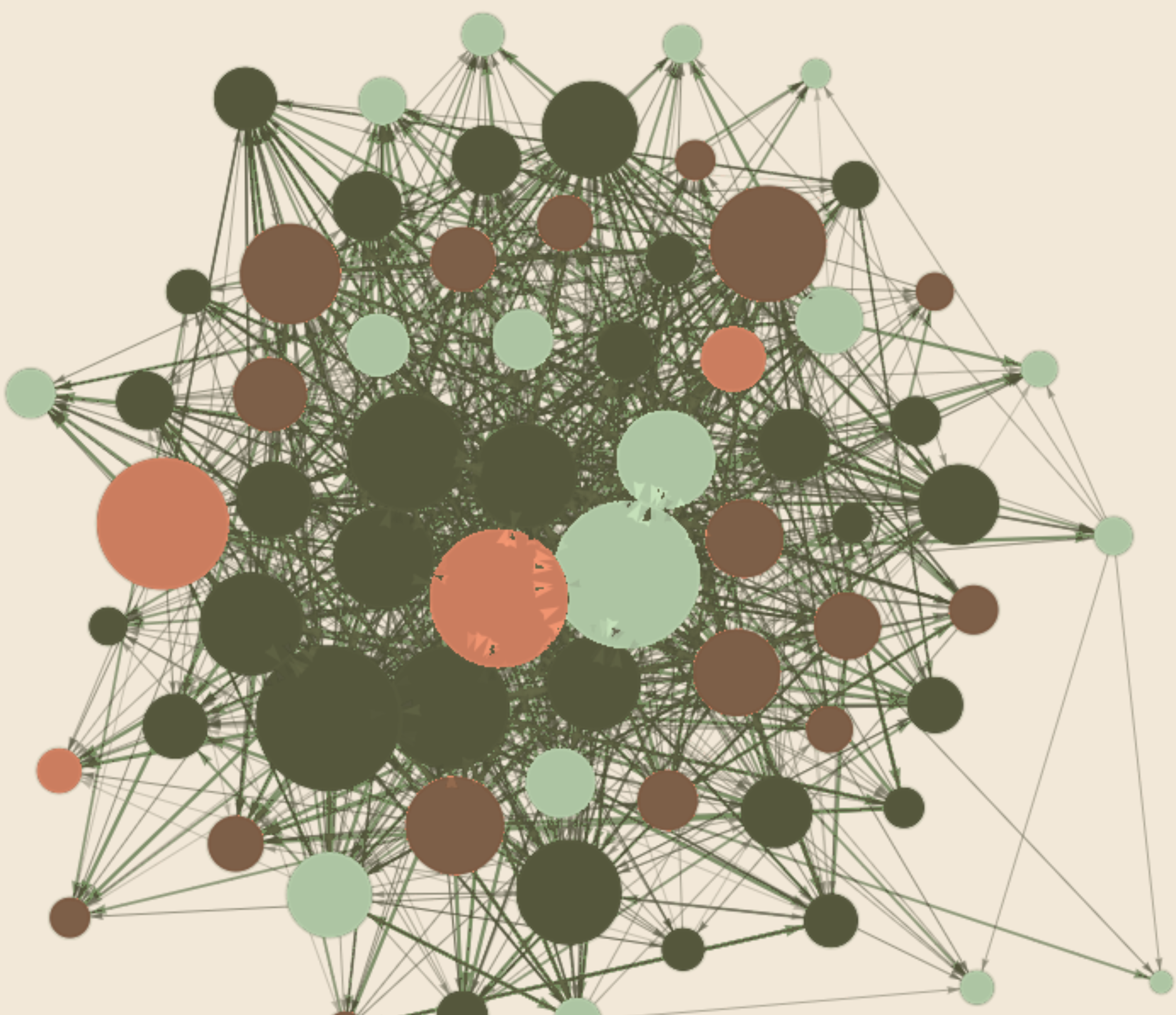
A Social Network Analysis (SNA) is a powerful visual and mathematical map of collaboration. It draws on network science to produce objective data on the types and strength of relationships, the exchange of information and resources, and the silos or gaps that exist.
An SNA answers questions most partnerships usually only guess at or intuit:
For a distributed, multi-sector network like Keeping Forests, answering these questions is essential to knowing where to direct resources, how to strengthen the connections that are thin, when to sharpen or adjust strategy, and how to make the collaboration measurably more effective. In other words, it turns what we can see about the network into what we can do about it.
Beyond Keeping Forests' organizational goals, we always intended for the SNA to be a tool for anyone who cares about the range of organizations and issues connected to Southern working forests. We wanted it to offer a way for organizations both within and outside of the network to locate themselves in a larger socio-economic and ecological picture, identify who they should be working with, and direct their own efforts where they will matter most.
In 2023, working with Visible Network Labs (VNL) and their expert network scientists, we conducted the SNA across the organizations that had been most engaged in Keeping Forests' collaborative work to develop and implement its strategies:

Since then, we've shared the results and what they mean through webinars, reports, workshops, and in-person meetings. We've used them to sharpen our own direction. Partners who took part received an organizational report with individualized guidance on applying their results within their own missions.
We also worked with VNL to host the full analysis and a set of semi-interactive visualizations online for anyone to access. But the format never let the data's full value come through. Partners couldn't see the Southern forest network through their own lens or shape it around the questions that mattered to them.
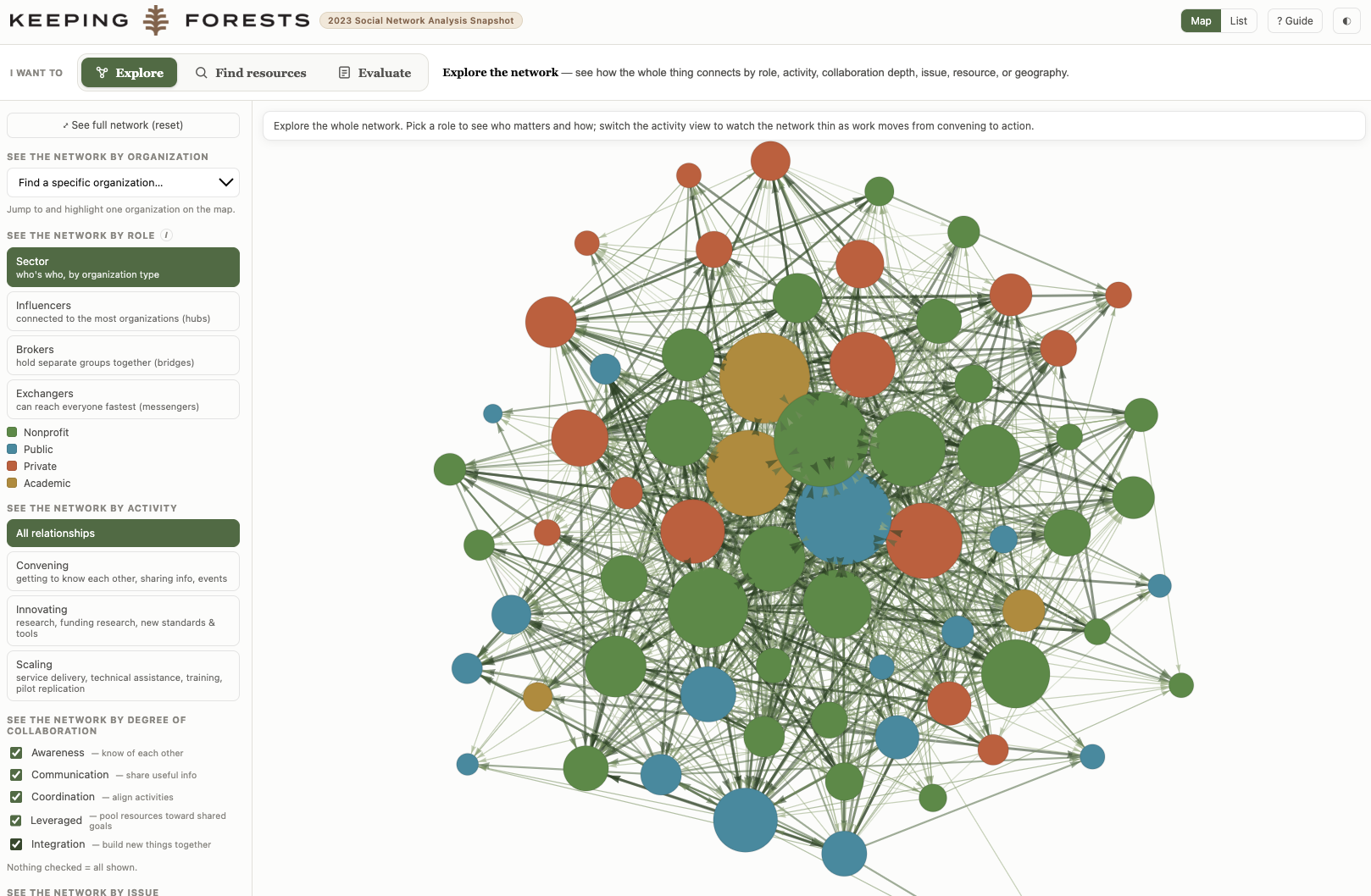
We built the Network Explorer for anyone with a stake in the future of Southern forests. In it, you can find the issues you care about and the organizations working on them. You can see where resources are available or needed. You can strengthen pathways to new partnerships, expand your work into new geographies, or identify what organizations are most effectively leveraging their resources.
Whether your organization was involved in the original analysis or not, the Network Explorer provides a wealth of information that can help advance your mission. We're excited to learn how you'll use it, what questions you ask of it, and how it helps you to move forward. When you win, we all win.
Here are a few of the ways we imagine it being used:
If there is an opportunity for future iterations, we will be able to widen the picture further, bringing in more organizations and sectors so the map keeps pace with the network it represents.
The Keeping Forests SNA and the Network Explorer provide a visualization of the aspects of networks that change the slowest.
According to VNL and network science literature, the day-to-day specifics move constantly, especially across three years that reshaped organizations, policy, and the economics of forest markets in a significant way. But the structural patterns an analysis like this captures (who sits at the center of the network, who bridges its otherwise separate parts, and how its sectors cluster or stay divided) are among the most durable features of any system.
Studies of organizational and social networks find that these patterns tend to hold, and to stay predictive, even as individual relationships and circumstances turn over. That is what makes a 2023 baseline worth using in 2026.
In the Keeping Forests Network Explorer, that means you can still:
And for the organizations that took part in the original analysis, the value is two-fold:
When we say the “Southern forest community,” we mean the network VNL mapped with us: the 68 organizations that took part in the analysis, working across the 13-state U.S. South on Southern forest conservation and markets.
One feature made this analysis unusual. Keeping Forests both defines the network, because we bounded (or defined) it around the work we do, and we sit inside it as a single member as an equal partner. Because every organization described its relationships to the others rather than only to us, the result is a portrait of the community itself, and Keeping Forests' place in it was set by how peers named us, not by how we describe ourselves.
According to the network scientists at Visible Network Labs, two characteristics make this network distinctive:
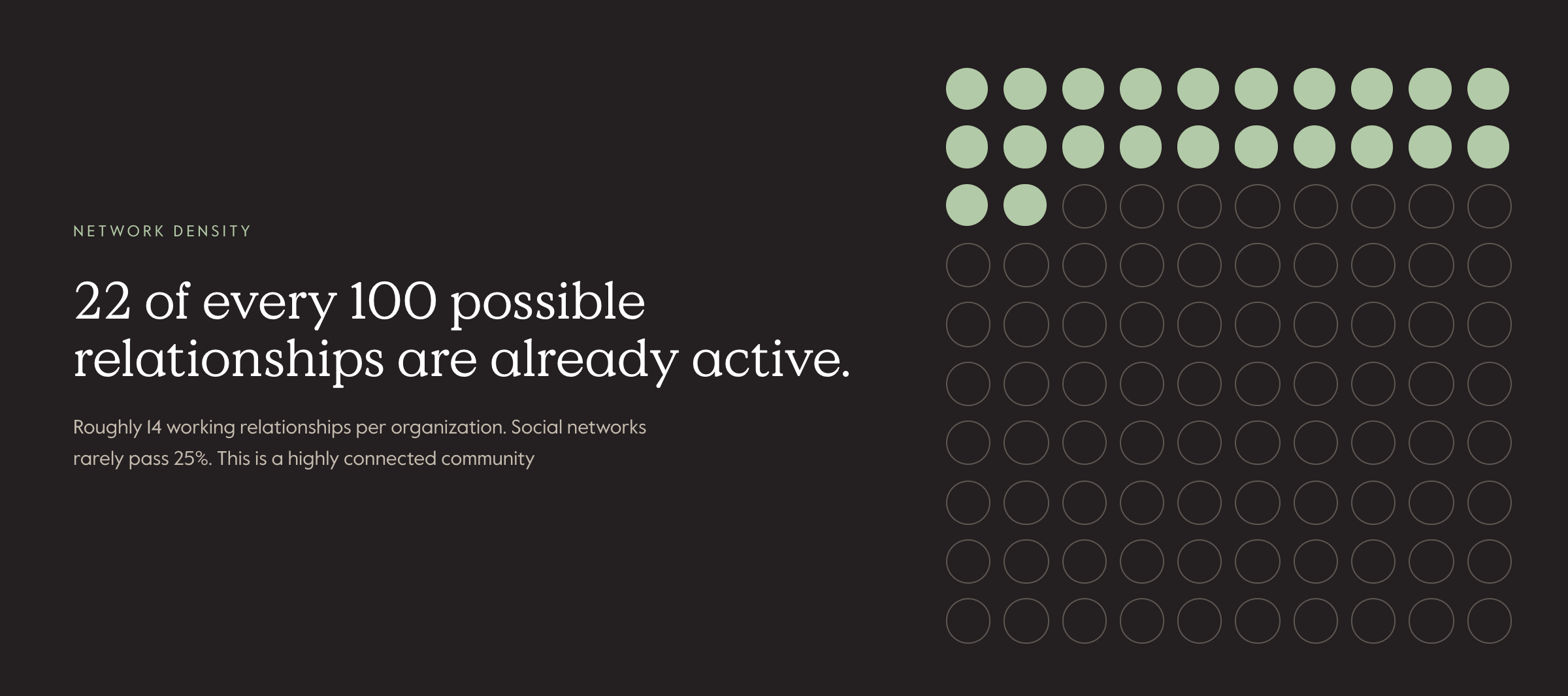
Despite that high trust, partners rated the value of their relationships lower (roughly 2.6 on the same scale), especially with respect to the tangible resources organizations contribute to one another and to the network. Funding, for instance, was among the least-offered contributions. Trust, in other words, runs ahead of tangible exchange.
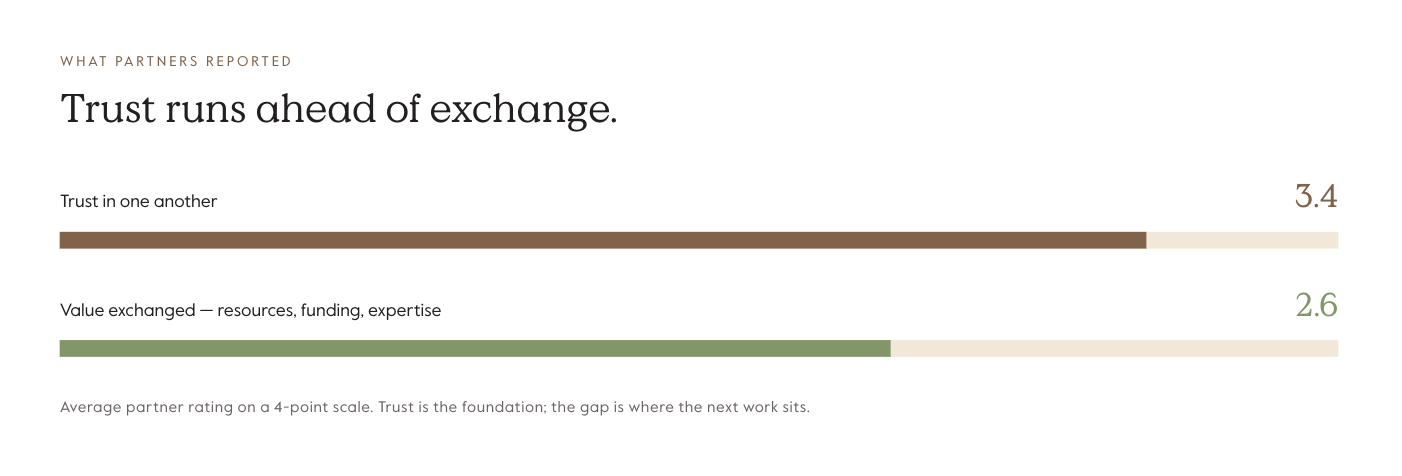
In VNL's reading, that positions the network well, because trust is the foundation that makes deeper, resource-level collaboration possible. But a network does not cross from strong relationships to real impact on its own. Without intentional strategy about how partners work together and where to direct resources, a network like this tends to stall at information-sharing, short of the scaling and systems-level change the work ultimately requires.
Network science looks at three kinds of key players, and they matter because the organizations in these positions hold the influence and the trust to move things through the network:
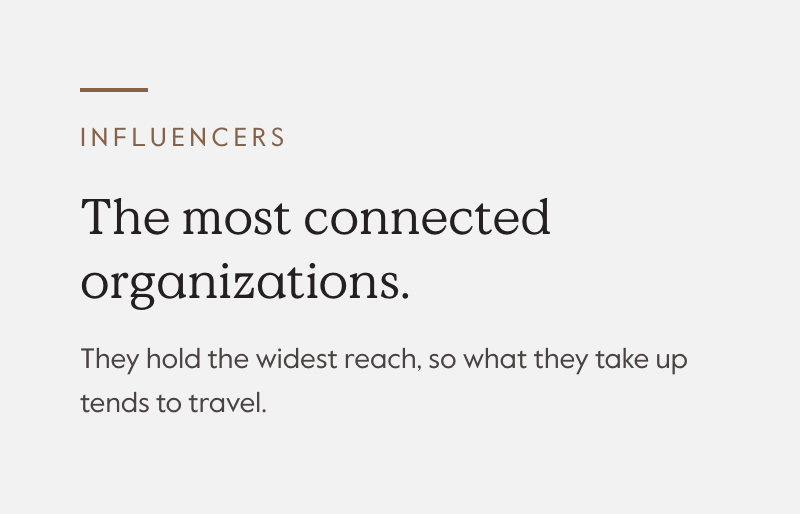
Influencers are the most connected. The analysis put the U.S. Forest Service, the Southern Group of State Foresters, NC State University's College of Natural Resources, Southern Regional Extension Forestry, and the U.S. Endowment for Forestry & Communities at the top.
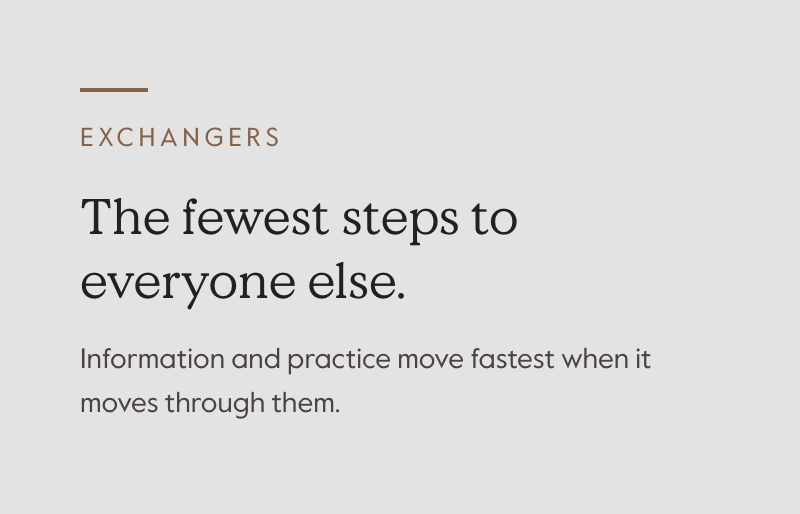
Exchangers can reach the rest of the network in the fewest steps, which makes them powerful for moving information and practices. The same five institutions lead this measure as well.
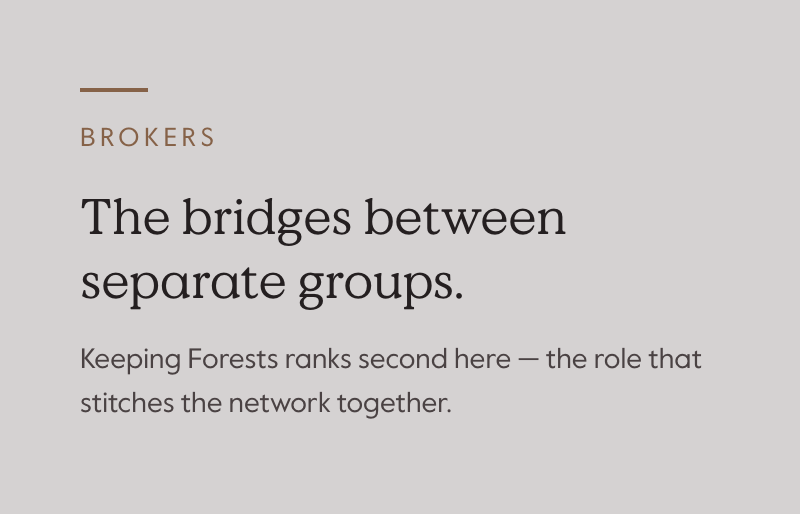
Brokers bridge otherwise-separate groups. Here the picture shifts: the U.S. Forest Service leads, followed by Keeping Forests, then the U.S. Endowment for Forestry & Communities, the Southern Group of State Foresters, and the National Alliance of Forest Owners.
Keeping Forests places in the top ten on all three measures. We ranked second only to the U.S. Forest Service as a broker, the role that stitches the network's separate parts together.
All of these standings were set by how peer organizations named one another, not by self-report. This is part of what makes an SNA powerful. It surfaces how partners actually relate to one another through cumulative data rather than subjective observation.
The U.S. South has a deep history of collaborating on conservation, and on forest conservation in particular. The region's work is carried by overlapping partnerships. A few of them:
Every one of these efforts depends on the same conditions our SNA and Network Explorer measure: a diverse set of organizations, connected by trust, each adding real resource value to a shared agenda.
In May 2026, the U.S. Forest Service (USFS), the U.S. Endowment for Forestry and Communities, and the Society of American Foresters (SAF) convened a gathering on forest markets in Madison, Wisconsin, called Markets Matter. Many of Keeping Forests' partners were in the room, including organizations represented in the SNA and Network Explorer.
The Markets Matter Action Plan that came out in July 2026 tracks closely with what our analysis was built to surface. It concludes that “no single product, policy or technology” will meet the challenge, and calls for “a coordinated and consistent effort,” including “building relationships with and connecting investors to project developers” and meeting “different regions where they are.”
In 2023, Keeping Forests was building toward exactly this kind of intention and measurement with our SNA and our approach to collaboration for the future of Southern forests. We understood then and now that coordination and connection are not givens. They are conditions, and conditions have to be intentionally designed, fostered, and measured.
Designing, fostering, and measuring those conditions is exactly what the SNA lets us do. It gave us a baseline read on the collaboration's health and a reference point to measure change against, and rather than sitting on a shelf, it reshaped how we work:
This is ongoing work. The new, interactive nature of the Network Explorer has opened up new ways to improve our relationships with partners, building trust and value across the network, and pinpointing the places that Keeping Forests (as an organization and as a partnership) can deliver the results our Southern working forests need most.
Keeping Forests exists to keep Southern forests working and thriving, and to serve as a trusted connector for the people doing that work. The map is one way we make that possible and keep our network visible, connected, and actionable.

Enter your email to access the brief.
Thank you for your interest in Keeping Forests. You can access the brief below.
DOWNLOAD THE BRIEF